
Given that I provide telehealth speech therapy for children with difficulty saying sounds and words, this is, of course, the most common question parents ask me.
It’s also one of the main things I consider when I complete a speech sound assessment.
One of the tools I use to answer this question is speech sound development norms.

What are speech sound development norms?
Speech sound norms are based on large groups of children and tell us roughly when most children learn to say certain sounds correctly.
Updated Australian-based research shows that:
- Early sounds like m, b, p, d, n, h, w, k, g, f, t, ng usually develop in the preschool years
- Middle sounds like s, z, sh, ch, j often come in a bit later
- Later-developing sounds like r and th may not be fully mastered until around 6 years
This means it is very normal for younger children to still be working on some sounds — especially the trickier ones.
Importantly, these norms are about when sounds are mastered, not when children start attempting them. Children don’t wake up one day suddenly being able to produce their k sounds correctly in all words, when they were previously producing them as a t sound.
Phonetic development vs phonological development
There are actually two different kinds of norms we look at:
1. Phonetic development (individual sounds)
This is about whether a child can physically produce a sound, like:
- Saying k
- Producing a nice, windy sounding sh
- Saying s clearly instead of a lisp
This is what most people think of when they hear “speech sounds”.
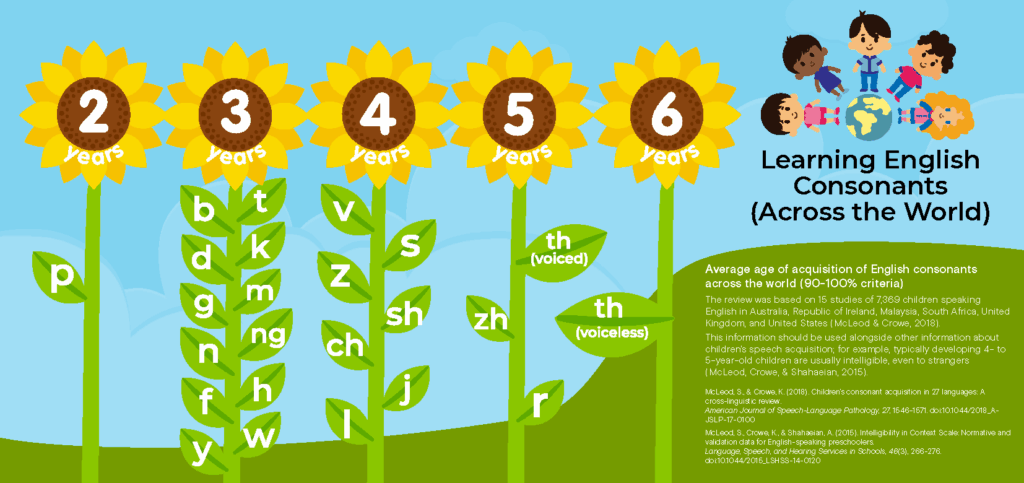
The information in the above picture is based on 15 studies of 7,369 children speaking English in Australia, Republic of Ireland, Malaysia, South Africa, United Kingdom, and United States (McLeod & Crowe, 2018). They stated that: “Five-year-old children have acquired most consonants within their ambient language; however, individual variability should be considered” (p. 1546).
(Picture retrieved from https://www.csu.edu.au/research/multilingual-speech/speech-acquisition/learning-english-consonants).
2. Phonological development (patterns)
Phonological processes are patterns your child’s brain uses to simplify speech as it’s developing. Instead of being about one single sound, they affect groups of sounds or whole word shapes. Many of these patterns are normal at younger ages and are expected to disappear gradually over time.
Some common examples include:
- Fronting – saying sounds made at the back of the mouth at the front instead (e.g. “tar” for “car”, “doe” for “go”)
- Cluster reduction – leaving out one sound when two or more sounds are together (e.g. “poon” for “spoon”, “tay” for “stay”)
- Final consonant deletion – leaving the last sound off a word (e.g. “ca” for “cat”, “beh” for “bed”)
- Stopping – replacing long, flowing sounds with shorter ones (e.g. “tun” for “sun”, “doo” for “zoo”)
You might notice that:
- Your child can say a sound or word correctly when you model it or ask them to repeat it
- But as soon as they go back to talking naturally, the error comes straight back
When you slow things down and ask your child to copy you, they’re using conscious effort to make that sound.
But in everyday speech, their brain automatically falls back on the phonological pattern it’s used to. That’s why the sound may seem to disappear again straight away.

Speech therapy for phonological difficulties focuses on helping the brain learn new patterns, not just correcting individual sounds. This is different to how therapy would look if a child has difficulty physically producing a sound.
To make things a bit more confusing, it’s quite common for children to have more than one type of error. So they might be using an incorrect phonological process, but also have difficulty producing the target sound as well.
Why norms aren’t the whole story
While norms are useful, they don’t tell us everything. As I discuss in this post, other important factors include:
- How easy your child is to understand in everyday conversations
- Whether your child is frustrated by being misunderstood regularly
- How speech difficulties are affecting confidence, learning, or friendships
- Whether errors are changing over time or staying the same
This is why two children the same age can have very different therapy needs — even if they have similar kinds of errors.
When should I seek advice?
You don’t need to wait until your child is “outside the norms” to ask questions.
A speech pathologist can help you understand:
- Whether errors are developmentally expected
- Whether patterns should be resolving by now
- What (if anything) to monitor or support at home
Sometimes reassurance is all that’s needed. Other times, early support can make a big difference.
Final thoughts…
Speech sound norms are a guide, not a deadline.
If you’re unsure about your child’s speech — especially if they’re hard to understand or they are becoming frustrated — getting individualised advice is always worthwhile.
Telehealth speech therapy makes it easy to access that support, wherever you are.
If you’d like help understanding your child’s speech development or whether telehealth therapy might be a good fit, feel free to get in touch.
